Maine Coon Colors and Patterns
Maine Coon Colors & Patterns – Complete Guide
Maine Coons exhibit an extraordinary variety of coat colors and patterns. The genetic palette is built around two pigment types: eumelanin (dark pigment) and pheomelanin (red pigment).
Modifier genes — such as the dilution gene, the agouti/tabby gene, and the silver/smoke gene — diversify what you see. The mixture of fundamental pigments (red and black), plus various modifier genes, results in over 75 different color combinations in Maine Coons.
*🖤 Solid Color Maine Coons: *
Maine Coons are famous for their luxurious coats and wide range of colors and patterns — but few looks are as striking as the solid color Maine Coon. These majestic cats display a single, even shade from nose to tail, giving them a bold and regal appearance that highlights their massive frame and flowing coat.
🧬 What Does “Solid Color” Mean?
A solid color Maine Coon (also called a self-colored cat) has one uniform color over its entire body, with no visible tabby stripes, ticking, or patterns (apart from red). The color is consistent from the roots of the fur to the tips.
True solids are rare because most cats carry tabby or pattern genes, and even “solid” red Maine Coons often show faint ghost stripes due to genetics.
To qualify as a solid:
- The color must be consistent and sound to the roots.
- There should be no visible banding or pattern when you part the coat.
- Nose leather and paw pads should match or complement the coat color.
👉 According to the [Maine Coon Cat Club], solids must not show any ghost tabby markings and should display rich, even coloration across the body.
🎨 Recognized Solid Colors in Maine Coons
Most cat registries, including the CFA, TICA, and CCA, recognize the following solid colors for Maine Coons:
🖤 Black (MCO n)
- A deep, rich jet-black coat, consistent from root to tip.
- Nose leather and paw pads: black.
- Coat may fade or “rust” slightly in sunlight but should remain dark and glossy.
🤍 White (MCO w)
- Pure, brilliant white caused by the dominant white gene (W), which masks all other colors and patterns.
- Eye colors: blue, gold, green, or odd-eyed.
- Nose leather and paw pads: pink.
💙 Blue (MCO a)
- The dilute form of black.
- Appears as a soft steel gray or bluish slate, even in tone.
- Nose leather and paw pads: blue-gray.
❤️ Red (MCO d)
- A rich, vibrant orange or copper-red coat.
- Due to the O (orange) gene, even solid red cats often display faint tabby markings (ghost stripes).
- Nose leather and paw pads: pink.
🍑 Cream (MCO e)
- The dilute version of red.
- Pale ivory, cream, or buff coloring that’s soft and warm in tone.
- Nose leather and paw pads: pink.
❗ Colors like chocolate, lilac, cinnamon, and fawn are not accepted in most breed standards (CFA, TICA) because they come from non-native genetic lines.
🔬 The Genetics Behind Solid Colors
The Agouti Gene (A / a)
- Determines whether the coat shows tabby markings.
- AA or Aa = tabby pattern visible
- aa = non-agouti (solid)
A solid-colored Maine Coon must have the non-agouti genotype (aa) to suppress tabby striping.
However, the red gene (O) can override this suppression — that’s why even “solid” red or cream cats often display faint tabby patterns.
The Dilution Gene (D / d)
Dilution Explained
“Dilute” refers to a genetic modification that lightens a base color.
- Black→ Blue (Diluted Black)
- Red → Cream (Diluted Red)
The dilution gene softens pigment expression in the hair shaft. A kitten must inherit the dilution gene from both parents to appear diluted.
- This gene lightens the base pigment:
- Black → Blue
- Red → Cream
The White Gene (W)
- The dominant white (W) gene masks all underlying pigment, resulting in a white coat.
- White Maine Coons may genetically be black, blue, or red underneath — but the white gene covers it entirely.
Other Modifiers
- The inhibitor (I) gene creates smoke or shaded coats (not true solids).
- The wide band (Wb) gene affects silver or golden tones, which are separate from solid categories.
🐾 Identifying a True Solid Maine Coon
Here’s what to look for when determining if a Maine Coon is a true solid:
- Consistent coat color from root to tip — no banding or variation.
- Matching paw pads and nose leather that correspond with coat color.
- No visible stripes or faint tabby marks, especially on the legs, tail, and face.
- No lighter undercoat — solids have pigment evenly distributed throughout the fur.
- Even tone in sunlight — some blacks may “rust” brown, which is natural but not ideal for showing.
💎 Why Solid Colors Are So Striking
Solid Maine Coons have a timeless, regal appearance. Their monochromatic coats highlight the breed’s large bone structure, luxurious maine, and bushy tail. Many cat lovers find that solids offer a bold contrast to the more common tabby or bi-color patterns.
Popular combinations:
- A black solid Maine Coon with golden eyes is the picture of feline elegance.
- A blue solid gives off a soft, silvery sheen.
- White solids look angelic — especially with odd-colored eyes.
🧠 Common Challenges with Solid Colors
- “Ghost” tabby markings: Particularly in red and cream cats, faint stripes may show through due to the genetics of the orange pigment.
- Color fading: Black coats may “rust” in sunlight or with age.
- Rarity in breeding: Producing true solids can be difficult since tabby genes are dominant.
- Disallowed colors: Chocolate, lilac, and cinnamon are not permitted in purebred Maine Coons registered with major associations.
| Base Color | Dilute Form | Nose & Paw Pad Color | Common Issues |
|---|---|---|---|
| Black | Blue | Black / Blue-Gray | Rusting, fading |
| Red | Cream | Pink | Ghost tabby marks |
| White | White | Pink | Deafness risk (blue-eyed) |
| Blue | Blue | Blue-Gray | Uneven shading in poor lighting |
| Cream | Cream | Pink | Slight striping may show |
🐾Tabby Patterns in Maine Coons: A Complete Guide
Tabby markings are among the most iconic and frequent in the Maine Coon breed. Understanding their variations and what they mean will help you appreciate your cat’s coat, identify what you’re looking at, or make an informed choice if you’re adopting or breeding.
🎨 What “Tabby” Means
The term “tabby” refers to a pattern of markings on the coat, rather than a standalone color. These markings include stripes, swirls, spots or ticks. In Maine Coons, the pattern is determined by genes such as the agouti gene (A/a), which controls whether tabby pattern is visible or the coat is non-agouti (solid).
All cats carry the basic tabby gene structure — even when it’s hidden (ghost markings) or suppressed by other modifiers.
🧱 The Main Tabby Pattern Variations
According to breed guides, the core tabby patterns in Maine Coons include:
Classic (Blotched) Tabby
- Broad, swirling markings, often resembling a bull’s-eye shape or marble effect on the sides of the body.
- Features: “M” on the forehead, strong lines over the head and shoulders, swirls on the cheeks.
- Example: A brown classic tabby Maine Coon with bold black swirls on a coppery background.
Mackerel Tabby
- Narrow, vertical stripes running down the sides of the cat’s body, often described as “fish-bone” pattern.
- Features: Stripes down body, “M” on forehead, tail with rings, legs with bracelets.
- Example: A blue mackerel tabby Maine Coon showing slate-blue stripes on a lighter blue-gray base.
Ticked Tabby
- Each hair shaft has alternating bands of light and dark colors, producing a salt-and-pepper, speckled or shimmering effect rather than obvious stripes or swirls.
- Features: Markings may show on face and legs, but body appears more uniform from a distance.
- Example: A silver ticked tabby Maine Coon with subtle base color and fine patterning.
Spotted Tabby (Less uniformly recognized)
- Some sources recognize a “spotted” tabby where the stripes are broken into spots. The gene may be a modifier of the mackerel or classic pattern.
- Features: Spots or rosettes across the sides instead of full stripes or swirls.
🎨 Tabby Colors & Combinations
Tabby patterns can occur on a wide range of base colors in Maine Coons. Some common ones include:
- Brown tabby (classic, mackerel, ticked) — the “traditional” look for Maine Coons.
- Blue tabby — the dilute form of black-based tabby.
- Red/orange tabby — often more vivid in tabbies; note red gene often shows tabby even when “solid.”
- Cream tabby — the dilute of red tabby.
- Silver tabby — a result of the silver-inhibitor gene; white undercoat with dark tabby markings.
When describing a tabby Maine Coon’s coat, you often combine the color + pattern (e.g., “Blue Classic Tabby”, “Brown Mackerel Tabby”, “Silver Ticked Tabby”).
🧬 Genetics Behind Tabby Patterns
- Agouti gene (A / a): A dominant gene (A) expresses the tabby pattern (agouti hairs). Non-agouti (a/a) suppresses visible tabby, resulting in “solid” or ghost-tabby effect.
- Pattern genes: Genes determine Classic (mc), Mackerel (Mc), Spotted (Sp) and Ticked (T) patterns. For example: Classic is recessive to Mackerel; Ticked may be dominant over both.
- Modifier genes: The silver inhibitor gene (I) suppresses yellow pigment, creating silver tabby effects. Dilution gene lightens base colors (black → blue, red → cream). These modifiers interact with tabby patterns.
🔍 Recognizing & Understanding Tabby Maine Coons
Here are features and “signs” to identify tabby patterns:
- The “M” marking on the forehead is common in tabby cats. While not unique to Maine Coons, it’s a helpful indicator.
- Leg bracelets (rings around legs) and tail rings often accompany the mackerel or classic.
- Bull’s-eye or target shapes on the sides are characteristic of classic tabbies.
- For ticked tabbies, often no large visible pattern from a distance; markings appear mostly on face, legs, tail.
- Some “tabby with white” variants combine white spotting with tabby pattern (legs, chest, belly show white).
✅ Why Tabby Patterns Matter in Maine Coons
- Tabby patterns are part of the breed’s heritage and aesthetic appeal — many early Maine Coons were brown tabbies.
- For breeders and show-standards: pattern clarity, contrast (markings vs ground color), leg and tail ring definition matter.
- For owners: Understanding the pattern helps you know what your cat is, what to expect in growth or adult appearance, and appreciate subtle differences (e.g., “tick vs classic”).
📝 Key Takeaways
- The three core tabby pattern types in Maine Coons are Classic (Blotched), Mackerel, and Ticked — with “Spotted” recognized in some sources.
- Tabby patterns can appear in many base colors: brown, blue, red, cream, silver.
- Visible tabby = agouti gene at work; non-visible (ghost) = non-agouti or solid suppressed pattern.
- Recognizing pattern features (M-mark, leg bracelets, tail rings) helps in identification and appreciation.
- Breeders and judges focus on clarity of markings, contrast, and adherence to pattern standards.
Bi-Color and Parti-Color (With White)
White spotting genes add white patches to any base color or pattern. These cats are known as bi-color or parti-color Maine Coons.
Examples include:
- Black and white
- Blue and white
- Red and white
- Cream and white
- Tortie and white (Calico)
The white pattern can range from small paws and chest spots to nearly all-white coats with a few colored patches.
White spotting overlays the existing color or pattern — it doesn’t change the underlying genetics.
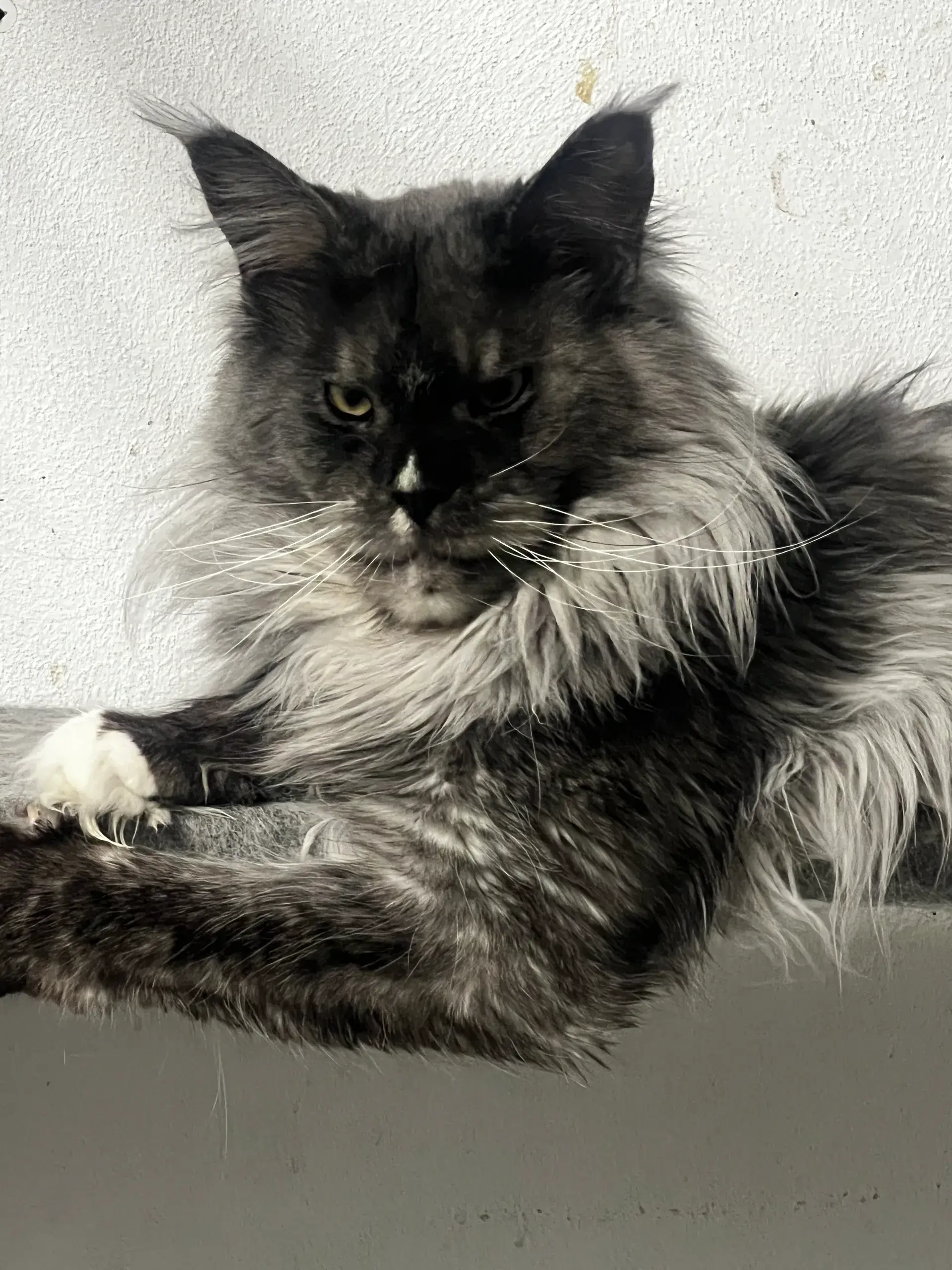
Tortoiseshell (Tortie) and Torbie
Definition and Appearance
- You’ll see the tabby M-shape on the forehead and distinct striping or marbling on the body.
- The red (or cream) and black (or blue) colors are clearly patterned rather than randomly mixed like in a tortie.
- The coat often shimmers, especially in silver torbies, making them look spectacular.
A tortoiseshell Maine Coon — often just called a tortie — has a coat that’s a blend of two colors:
- Black (or its dilute version, blue)
- Red (or its dilute version, cream)
The colors are usually mixed or mottled together, rather than appearing in distinct patches.
Typical Tortie Colors
Base (non-dilute) Dilute version
Black + Red Blue + Cream
So, you might see:
- Black Tortie: black mixed with red or orange
- Blue-Cream Tortie: gray-blue mixed with pale cream
Pattern Appearance
- The mix can appear like a marble swirl, freckled pattern, or patchy blend.
- No two torties look alike — each one has a unique pattern.
- Torties often have splashes of color on the face, like one orange patch over one eye.
Genetics
- Torties are almost always female, because the color genes for red and black are both located on the X chromosome.
- Males have only one X chromosome (XY), so they usually can only be one color.
- Very rarely, a male tortie can exist if he has an extra X chromosome (XXY), but those males are typically sterile.
Personality Note (folklore)
Many cat owners talk about “tortitude” — a nickname for the confident, sometimes sassy personality torties are said to have. While not scientifically proven, tortie Maine Coons are often described as spirited and strong-willed.
- The torbie pattern occurs when a tortie cat inherits the tabby gene (Agouti gene).
- So, a torbie is literally a tortie with tabby expression showing through.
🧡
In short:
| Feature | Tortie | Torbie |
|---|---|---|
| Color Mix | Black + Red (or Blue + Cream) | Same, but with Tabby stripes |
| Pattern | Mottled or marbled | Striped or marbled with tabby markings |
| Gender | Almost always female | Almost always female |
| Example | Black + red mottled | Brown tabby + red striped |
Smoke, Shaded, and Silver Variants and The Genetics Behind It
All of these coat types — smoke, shaded, and silver — come from the action of the inhibitor gene (I).
- · The inhibitor gene stops pigment from forming in the base (root) of each hair.
- The result: the hair appears light (white or silvery) near the skin, and only the tips are colored.
- Depending on how much of the hair is colored, you get different effects: smoke, shaded, or tipped/silver.
*Smoke Maine Coons *
Definition:
A smoke Maine Coon looks is a solid color at first glance, but when they move or when the fur parts, you can see a pale silver-white undercoat. Smoke cats carry two solid genes.
How it works:
- The top 50–80% of each hair is pigmented (black, blue, red, etc.),
- The bottom 20–50% is white or pale silver.
- The contrast is most visible when the coat is blown back or brushed open.
Examples:
- Black Smoke: black-tipped hairs with a white base (very dramatic).
- Blue Smoke: gray-blue tips with a pale silver undercoat.
- Red Smoke: orange tips with a warm cream base.
- Cream Smoke: pale cream tips over a whitish base.
Appearance:
They often look solid-colored at rest, but when they walk or the fur moves, you see that “smoky” shimmer — like a hidden silver glow.
Shaded Maine Coons
Definition:
A shaded Maine Coon has less color on the hair shaft than a smoke — the tipping only covers about the upper 1/3 to 1/2 of each hair. Shaded cats carry two tabby genes.
Effect:
This creates a beautiful gradient, where the cat appears lighter overall but still carries depth of color on the back and sides.
Examples:
- Black Shaded Silver: dark gray shading over a silver-white base.
- Red Shaded Silver: warm red-tipped hairs over a cream-silver base.
- Blue Shaded Silver: soft gray-blue tipping over silver-white.
Appearance:
They look lighter and more ethereal than smokes, often with a pearly shine and darker “mantle” (back and head area).
✨ Silver (Tipped or Chinchilla) Maine Coons
Definition:
In the most extreme form of the shading pattern, only the very tips (1/8 of the hair) carry color. This produces a nearly white or pale silver cat with just a “dusting” of pigment. Silver cats carry at least one tabby gene.
Examples:
- Silver (Chinchilla) Maine Coon: almost pure white coat with just a whisper of black or blue tipping.
- Red Silver (Cameo): very pale cream or pinkish-gold shimmer from faint red tipping.
Appearance:
- They look bright white with a metallic glint, especially in sunlight.
- Eye color is often green or gold, which enhances the contrast.
🧬 Summary Table
| Variant | Pigment Coverage on Hair | Overall Look | Common Colors | Notes |
|---|---|---|---|---|
| Smoke | 50% to 80% of each hair pigmented | Looks solid until moved; silver undercoat visible | Black, Blue, Red, Cream | Deep, dramatic contrast |
| Shaded | 30% to 50% pigmented | Gradient effect; lighter coat overall | Black Shaded Silver, Red Shaded Silver | Soft, shimmering tones |
| Silver / Tipped | 10% to 20% pigmented | Almost white with colored tips | Silver (Chinchilla), Cameo | Very pale, sparkling look |
Visual Tip
- Smoke = mostly dark, silver shows when the fur moves.
- Shaded = visibly lighter, with a soft gradient from dark to light.
- Silver (Tipped) = nearly white, just faint color dusting.
Breed Registry Standards
Most cat associations, including TICA (The International Cat Association) and CFA (Cat Fanciers’ Association), recognize Maine Coons in nearly all color and pattern combinations except chocolate, lilac, cinnamon, fawn, and color-pointed varieties.
Example EMS Color Codes
| EMS Code | Description | Example |
|---|---|---|
| MCO n 22 | Black Classic Tabby | Brown tabby |
| MCO a 22 | Blue Classic Tabby | Diluted black |
| MCO e | Cream Solid | Diluted red |
| MCO f 03 | Black Tortie & White | Tortie with white |
| MCO ds 11 | Red Silver Shaded | Red with silver undercoat |
👉 [Full EMS Code Chart – Maine Coon Cat Club]
💡 Quick Color ID Tips
- “M” on the forehead → Tabby pattern
- Lighter undercoat → Smoke or silver gene
- Mix of black & red patches → Tortie or Torbie
- Pink nose & paw pads → Cream or red variants
🧾 References
- Maine Coon Central – Colors & Patterns
- Maine Coon Country – Genetics & Variations
- MCBFA – Color Guide
- TICA Breed Standard
- Maine Coon Cat Club – EMS Codes
- Maine Coon Central – Colors & Patterns Guide
- Maine Coon Country – Color Genetics & Variations
- Maine Coon Cat Club – Breeding Policy & Color Standards (2024)
- Canadian Cat Association – Maine Coon Breed Standard
- Mythical Meow Maine Coon – Coat Colors Explained
- Maine Coon Kitty Cats – Maine Coon Color Chart
- Just Cat Café – Rare Colors of Maine Coons
- PetsCare – Maine Coon Types: Guide to Colors & Patterns
- Maine Coon Central – Maine Coon Colors: Rare Shades, Patterns & Genetic Secrets!
- MaineCoonEducation.com – Pattern: The Maine Coon Breed Colors
- LoveMaineCoon.com – Maine Coon Tabby: Stripes Of The Main Star
- Cat Fanciers’ Association – Maine Coon Breed Standard: Tabby Patterns and Colors
- MeowBeans – Maine Coon Colors & Patterns: A Complete Guide
